
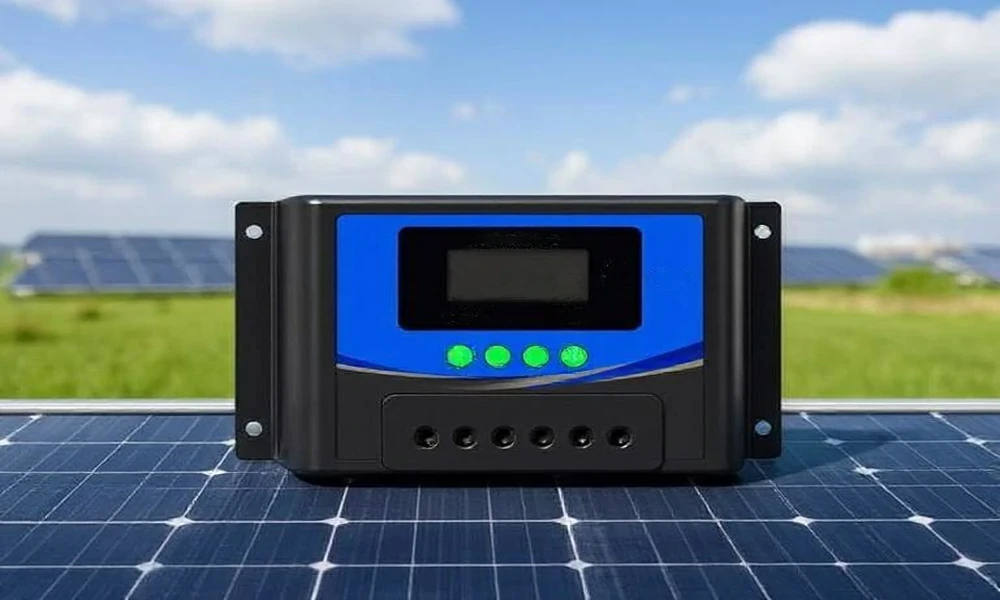
A solar panel charge controller has a straightforward but important job: it regulates the electricity flowing from a solar panel to a battery. The controller helps manage charging and protects the battery from conditions such as overcharging and reverse current.
Two technologies commonly appear in solar charging systems: PWM (Pulse Width Modulation) and MPPT (Maximum Power Point Tracking). Neither should be selected simply because it is newer or more widely marketed. The better choice depends on the solar-panel voltage, battery voltage, system size, available sunlight and budget.
For a small off-grid installation with a closely matched panel and battery configuration, PWM can be a practical solution. MPPT generally has an advantage when the solar array operates at a higher voltage than the battery or when maximising available solar energy is a priority.
What does a solar charge controller do?
A solar panel charge controller regulates the power moving between the solar array and the battery.
Solar panels do not produce a constant voltage or current. Their electrical output changes with sunlight and operating conditions. The controller manages that variable input and applies an appropriate charging process for the connected battery.
| Controller function | Purpose |
| Charge regulation | Controls the charging process |
| Overcharge protection | Helps prevent excessive battery charging |
| Reverse-current protection | Prevents unwanted current flowing back towards the panels |
| Battery-voltage management | Matches charging to the connected system |
| Charging stages | Controls different phases of battery charging |
| System protection | Helps protect connected components from specified electrical conditions |
The solar panel charge controller therefore needs to be selected according to the panel array and battery rather than by current rating alone.
PWM: A straightforward approach for smaller systems
PWM stands for Pulse Width Modulation. A PWM controller regulates charging by rapidly switching the connection between the solar panel and battery.
During charging, the panel’s operating voltage is pulled towards the battery voltage. This makes PWM relatively simple and economical, but it also means that when a panel’s operating voltage is significantly higher than the battery’s charging voltage, some of the panel’s potential power is not converted into additional charging power.
That characteristic makes PWM particularly suitable for smaller systems where the panel and battery voltages are appropriately matched.
For example, a small 12V battery system using a suitably matched solar panel can work effectively with a PWM controller without the additional cost of MPPT being necessary.
MPPT: More effective use of available panel power
MPPT stands for Maximum Power Point Tracking. An MPPT charge controller tracks the point at which a solar panel or array can deliver its maximum available power. It then converts that power to a voltage suitable for charging the battery.
The important advantage is that the panel does not have to operate at the same voltage as the battery. If the array’s optimum operating voltage is higher, an MPPT controller can convert the available power more effectively. That does not make the MPPT charge controller the automatic choice for every small installation. The additional cost should be weighed against the amount of extra energy the controller can realistically capture.
MPPT vs PWM at a glance
| Factor | PWM | MPPT |
| Full form | Pulse Width Modulation | Maximum Power Point Tracking |
| Charging approach | Regulates panel-to-battery connection | Tracks the array’s maximum power point and converts available power |
| Relative cost | Generally lower | Generally higher |
| Panel-voltage flexibility | More limited | Greater |
| Energy harvesting | Can leave potential power unused when panel and battery voltages differ significantly | Generally makes better use of available panel power |
| Small, simple systems | Often suitable | Can be suitable but may cost more than necessary |
| Larger or more demanding systems | Suitability depends on configuration | Often advantageous |
| Main selection criterion | Correct panel/battery matching | Correct array, battery and MPPT operating-range matching |
The comparison is about system design, not a universal winner.
When is PWM the sensible choice?
PWM can make sense when the solar panel’s voltage is well matched to the battery system and the installation has modest energy requirements.
Cost can also be a consideration. If a small system does not gain enough additional energy from MPPT to justify its higher purchase price, PWM may provide a more economical solution. The controller’s rated current and supported solar capacity still need to be respected. A controller that is appropriate for a small array should not be connected to a larger array simply because its battery voltage is compatible.
How should you read the controller rating?
Consider a 20A controller specified for a 12V system and a maximum solar input of 400Wp. That rating gives the installer a defined operating range within which the controller is designed to work.
A 24V configuration may support a higher panel capacity on the same controller because the power represented by a given current is higher at the higher system voltage. This is why simply asking for a “20A solar controller” is not enough. The battery voltage and maximum supported PV capacity need to be checked together.
The current SCC 1220NM, for example, is specified for 12V and 24V systems, with maximum solar capacities of 400Wp and 800Wp respectively.
When does MPPT become more attractive?
MPPT becomes increasingly useful when the solar array’s operating voltage differs substantially from the battery voltage. It can also be worthwhile when roof space is limited, and the system needs to extract as much available power as possible from the installed panels.
Changing weather conditions are another consideration. Solar-panel output varies as sunlight changes, and MPPT continuously tracks the array’s maximum power point rather than operating at one fixed point. However, the practical gain depends on the complete system. An MPPT controller does not compensate for an undersized solar array, excessive shading or an incorrectly sized battery.
Don’t confuse a charge controller with an inverter
A standalone charge controller and a solar inverter perform different functions.
| Equipment | Main job |
| Solar charge controller | Regulates solar charging of the battery |
| Solar inverter | Converts DC electricity into AC electricity for compatible household loads |
| Off-grid solar inverter with integrated charging functions | Can combine inverter and solar-charging functions in one unit |
| Hybrid inverter | Manages solar, battery and grid power according to its configuration |
Some off-grid and hybrid inverters incorporate solar charging technology, so a separate charge controller may not be required. The system design should determine whether the controller is a standalone component or already integrated into the inverter.
What should you check before buying?
Five specifications deserve particular attention:
- Solar-panel voltage: Check the panel’s operating and open-circuit voltage against the controller’s input limits.
- Battery voltage: Confirm whether the controller supports the intended 12V, 24V or other system voltage.
- Solar capacity: Stay within the controller’s specified maximum PV capacity.
- Battery compatibility: Make sure the charging profile is appropriate for the battery being used.
- Protection features: Check the controller’s stated protections and charging functions.
For lithium-ion batteries in particular, compatibility should be verified against the exact controller or inverter model rather than assumed from the battery chemistry alone.
Choosing between PWM and MPPT
For a small, straightforward off-grid system with appropriately matched panel and battery voltages, PWM can be a sensible and economical choice. You will find many relevant options with PWM solar panel charge controllers available across different current and system-voltage ratings.
MPPT is generally the stronger technical option when the solar array benefits from operating at a higher voltage, when available roof space makes energy harvesting especially important or when changing conditions make maximum-power tracking valuable. The decision should therefore begin with the electrical design rather than the solar panel charge controller label.
Reliable brands such as Luminous can provide a useful starting point because their current product pages publish model-specific ratings, supported system voltages and solar-input capacities. Those specifications allow the controller to be evaluated against the actual solar array and battery rather than selected on brand or current rating alone.
A good solar panel charge controller is ultimately one that fits the system around it. PWM remains appropriate for many small, well-matched installations, while MPPT can deliver greater energy-harvesting potential where its additional capability is useful. The right choice is the one that balances electrical compatibility, expected performance and cost for the specific installation.
