
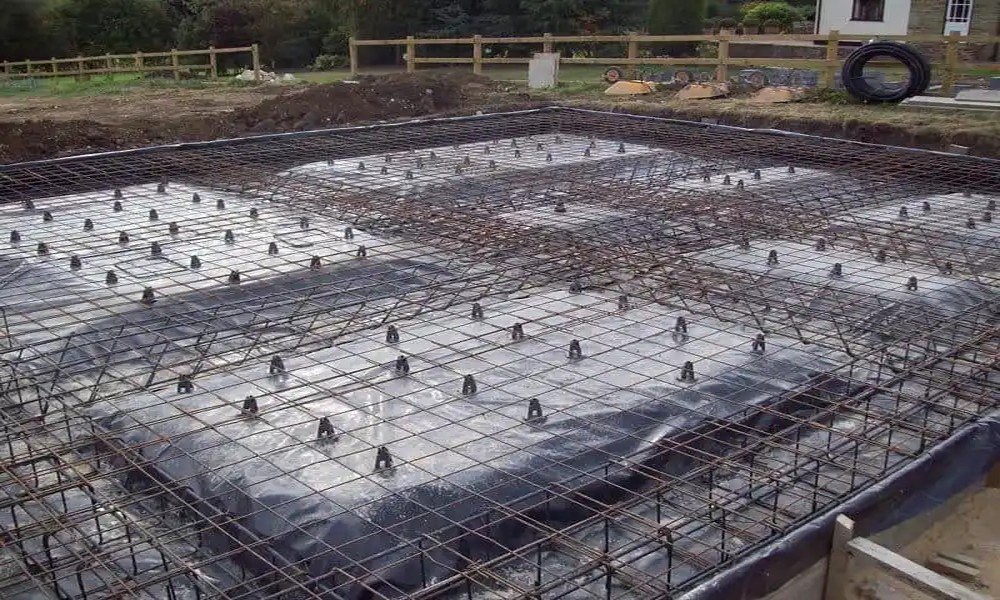
How They Support Buildings on Weak Soils and Ensure Structural Stability
A building is only as strong as the ground it stands on. When soil conditions are weak, compressible, or inconsistent, traditional foundation systems may struggle to provide adequate support. This is where raft foundations-also known as mat foundations-become an essential engineering solution.
In this guide, we’ll break down what raft foundations are, how they work, their benefits, design considerations, and where they are best applied.
What is a Raft Foundation?
A raft foundations is a large reinforced concrete slab that covers the entire footprint of a building. It supports all structural elements-columns, walls, and partitions-by distributing the load evenly across the soil.
Unlike isolated footings that transfer loads at specific points, a raft foundation acts as a single unit, reducing stress on the soil and enhancing stability.
How Raft Foundations Work
The principle behind raft foundations is simple: increase the area over which the building load is distributed. By spreading the load across a wide surface, the pressure on the soil is significantly reduced.
This approach:
- Minimizes settlement
- Reduces differential settlement
- Improves load distribution
- Enhances overall structural performance
In effect, the structure “floats” on the soil, maintaining stability even when ground conditions vary.
Why Raft Foundations Are Ideal for Weak Soils
Weak soils such as clay, silt, and loose sand often have low bearing capacity and are prone to movement. Raft foundations address these issues by:
- Spreading loads over a large area
- Reducing soil pressure
- Providing a rigid base
- Preventing uneven settlement
They are especially effective in areas with high groundwater levels or varying soil strata.
Types of Raft Foundations
1. Flat Plate Raft
A simple slab of uniform thickness, suitable for light to moderate loads.
2. Beam and Slab Raft
Includes beams integrated into the slab to increase stiffness and load capacity.
3. Cellular Raft
A grid-like structure with hollow spaces, used for heavy loads and very weak soils.
4. Piled Raft Foundation
Combines a raft with piles to transfer part of the load to deeper, stronger soil layers.
Key Benefits of Raft Foundations
Uniform Load Distribution
Raft foundations distribute loads evenly, reducing stress concentrations on weak soil.
Reduced Differential Settlement
They act as a rigid unit, minimizing uneven settlement and preventing structural damage.
Improved Stability
Provides a strong and stable base even in challenging soil conditions.
Cost Efficiency for Large Projects
More economical than multiple footings in large or heavily loaded structures.
Faster Construction
Simplified excavation and formwork speed up the construction process.
Suitable for High Water Table Areas
Performs well without requiring deep excavation.
Design Considerations
Soil Investigation
A detailed geotechnical study is essential to assess soil properties and bearing capacity.
Load Analysis
Includes calculation of dead loads, live loads, and environmental forces.
Thickness and Reinforcement
Determined based on structural loads and soil conditions.
Settlement Control
Design must ensure settlement remains within safe limits.
Waterproofing and Drainage
Important for areas with high groundwater levels.
Applications of Raft Foundations
Raft foundations are widely used in:
They are particularly useful when soil conditions are inconsistent across the site.
Raft Foundation vs Traditional Foundations
Traditional foundations such as isolated footings are effective in strong soils but may not perform well in weak or variable conditions. Raft foundations provide a unified support system, reducing the risk of settlement and structural issues.
Conclusion
Raft foundations are a reliable and efficient solution for building on weak soils. By distributing loads evenly and minimizing settlement, they ensure structural stability and long-term performance.
For any construction project, understanding soil conditions and selecting the right foundation system is critical. In challenging environments, raft foundations often provide the safest and most economical choice.
