
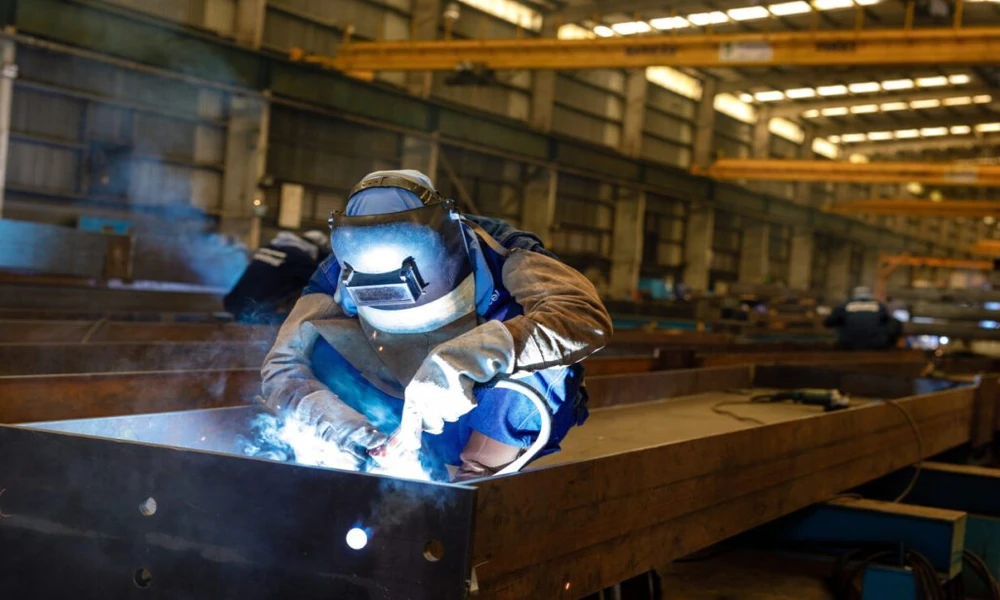
When you see a large storage tank, a structural steel frame, or a custom pressure vessel installed at an industrial facility, there’s a good chance it didn’t arrive in pieces and get assembled on the spot by trial and error. It was fabricated somewhere else first, in a controlled environment purpose-built for precision metalwork, then transported and installed once the hard work was already done. That process is called shop fabrication, and it’s one of the foundational methods behind modern industrial construction.
The Basic Definition
Shop fabrication refers to the manufacturing of metal components, structures, or assemblies in a dedicated facility before they’re delivered to a job site. The “shop” in shop fabrication is a fabrication shop, which is a specialized workspace equipped with welding stations, cutting tools, forming equipment, cranes, inspection areas, and the skilled tradespeople who operate them. Rather than building something from scratch in an open field or at an active industrial plant, fabricators complete as much of the work as possible under controlled conditions and ship finished or semi-finished components ready for final installation.
The contrast to shop fabrication is field fabrication, where components are cut, welded, and assembled directly at the installation site. Both methods have their place in industrial construction, but shop fabrication is generally preferred when precision, quality control, and efficiency are the primary concerns, which in most industrial applications they are.
What Gets Built in a Fabrication Shop
The range of products that come out of fabrication shops is broad. Storage tanks are among the most common, including above-ground tanks for oil, water, chemicals, and agricultural products. Pressure vessels, heat exchangers, pipe spools, structural steel assemblies, custom brackets and supports, hoppers, conveyors, and specialty enclosures are all standard fabrication shop outputs. Geodesic dome structures, which are used to cover large tanks and bulk material storage areas, are another product category that lends itself particularly well to shop fabrication because of the precision required in their component geometry.
The common thread across all of these products is that they involve metal, they require controlled forming and joining processes, and their final quality depends heavily on the environment and expertise available during manufacturing. A fabrication shop provides all of those things in ways that an open job site simply cannot replicate.
Why Shop Fabrication Produces Better Results
The quality advantages of shop fabrication over field fabrication come down to environment and control. Welding quality is significantly easier to maintain indoors, away from wind, precipitation, and temperature fluctuations that affect the metallurgical integrity of a weld. Fabrication shop welders work at fixed stations with proper ventilation, consistent lighting, and access to the full range of equipment they need without having to haul it across a job site. That consistency produces cleaner, more reliable welds that are easier to inspect and certify.
Dimensional accuracy is another area where shop fabrication excels. Cutting, rolling, and forming metal to precise specifications is far more achievable on a flat, level shop floor with calibrated equipment than it is outdoors on uneven terrain. When components need to fit together within tight tolerances, the controlled environment of a fabrication shop is where that kind of precision gets achieved. Errors caught in the shop are corrected before anything ships. Errors discovered in the field are expensive, time-consuming, and sometimes impossible to fix without significant rework.
The Role of Welding Certifications and Quality Standards
Shop fabrication is a regulated discipline. Reputable fabrication shops operate under third-party quality certifications and follow established codes that govern how specific types of components must be designed, welded, inspected, and tested. The American Welding Society, the American Society of Mechanical Engineers, and the American Petroleum Institute all publish standards that apply to different categories of fabricated products, and certified fabrication shops are audited against those standards on a regular basis.
For customers procuring fabricated components, these certifications matter enormously. They represent independent verification that a shop’s processes, personnel, and equipment meet the technical requirements necessary to produce components that are safe and fit for purpose. When a storage tank or pressure vessel carries an ASME stamp, for example, it means the fabrication process was reviewed and approved by a qualified inspector at multiple stages, not just at final delivery.
How Shop Fabrication Fits Into a Larger Project
On a typical industrial construction project, shop fabrication sits early in the schedule. Engineering teams produce detailed drawings and specifications, fabricators translate those documents into physical components, and those components ship to the job site where installation crews connect them to foundations, piping systems, and other infrastructure. The sequencing matters because shop fabrication lead times need to be accounted for in project planning. A tank that takes eight weeks to fabricate needs to be ordered well before the concrete pad it will sit on is poured.
Experienced project managers treat fabrication lead time as one of the earliest scheduling constraints to nail down, because delays in the shop ripple forward into every downstream phase of a project. Contractors who operate their own fabrication shops, rather than outsourcing to third parties, often have a scheduling advantage because they control that variable directly and can communicate production status in real time.
Transportation and Delivery Considerations
One practical constraint of shop fabrication is that finished components have to get from the shop to the job site, and for large industrial products that’s not a trivial undertaking. Oversized loads require permitted routes, escort vehicles, and coordination with state transportation departments. Tanks and vessels that exceed highway width or height limits may need to be partially disassembled for transport and completed in the field, which introduces a hybrid approach that combines the quality benefits of shop work with some degree of field assembly.
Fabricators who work regularly in specific regional markets develop familiarity with the transportation logistics of those areas, including which routes accommodate wide loads, which permits are required in which jurisdictions, and how to sequence delivery to minimize site storage time. That regional experience is part of what differentiates a fabricator who operates locally from one shipping components across the country.
Why Industrial Buyers Choose Shop Fabrication
For the engineers, procurement managers, and project owners who specify fabricated components, the decision to use shop fabrication over field alternatives almost always comes down to three things: quality, schedule predictability, and risk reduction. Shop fabrication concentrates skilled labor and specialized equipment in one place, which is inherently more efficient than mobilizing those resources to a remote job site. It keeps quality control under the fabricator’s direct supervision rather than dependent on field conditions. It also means that the bulk of manufacturing risk is absorbed before installation begins, which simplifies the work that has to happen at the site itself.
Industrial facilities operate on tight schedules and tighter budgets, and the components that keep them running need to be right the first time. Shop fabrication exists because the alternative, building everything from scratch in the field, introduces too many variables that are difficult to control and expensive to correct. The fabrication shop is where precision happens, and precision is what industrial infrastructure depends on.

Comments are closed.