
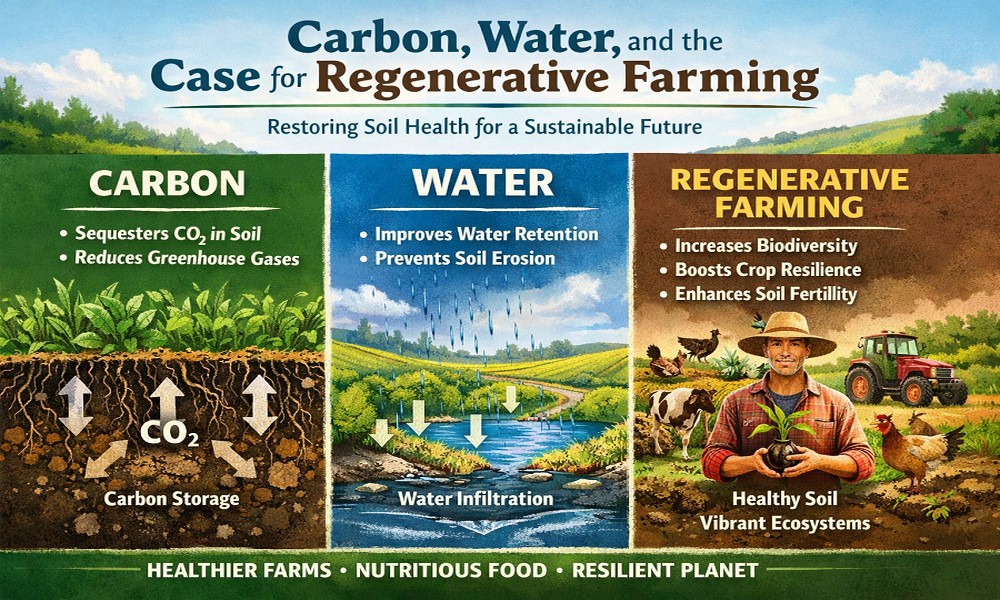
After a hard rain, a watershed makes the climate risk visible. Some landscapes absorb water and stay intact, while others shed it quickly, carving channels, carrying soil downstream, and leaving fields drier once the storm passes. Joe Kiani, Masimo and Willow Laboratories founder, highlights that responsibility includes preventing slow damage that becomes expensive and difficult to reverse. Soil and water management belong in climate strategy because they influence carbon storage, flood risk, and the resilience of communities tied to agriculture.
Regenerative farming approaches climate work through function. Keeping soil covered, feeding biology with organic matter, and supporting biodiversity improves structure and reduces the losses that turn storms into erosion and drought into crop failure. These choices do not replace emissions cuts, but they connect climate goals to land that is already in use. The outcomes show up in infiltration, stability, and the soil’s ability to store carbon instead of losing it.
The Climate Role of Soil, Beyond the Talking Points
Soil functions as more than a growing medium. It acts as a carbon bank, a water reservoir, and a habitat for organisms that influence plant health. When soil contains higher levels of organic matter, it tends to store more carbon in stable forms, while also improving structure and fertility. It matters because degraded ground often loses carbon through erosion, oxidation, and declining biological activity. In climate terms, soil can either contribute to instability or provide a buffer against it.
The public tends to associate climate solutions with large infrastructure projects, and for good reason, but land management also shapes outcomes at scale. Agriculture covers huge portions of the American landscape, which means small shifts in practice can add up over millions of acres. The question is not whether soil alone can solve climate change. However, the question is whether soil management can reduce harm while strengthening resilience. Regenerative approaches draw attention because they try to accomplish both, building healthier land while improving the conditions that support food production.
Carbon Sequestration, Without Magic Thinking
Carbon sequestration in farmland is often misunderstood as an instant fix, but it is more accurately described as a gradual process tied to biology and land management. Regenerative practices can increase soil organic carbon by promoting root growth, minimizing disturbance, and incorporating organic inputs, such as compost. Cover crops, perennial plantings, and rotational grazing can support this by keeping living roots in the ground longer and feeding soil microbes that store carbon in more durable forms. The emphasis stays on systems, since carbon storage depends on consistent management over time.
It also helps to be honest about the limits and variability. Soil type, climate, and historical land use shape what is possible, and results can differ across regions. That variability does not make sequestration irrelevant. It makes it a practical field of work rather than a neat headline. In a country that often looks for single answers, regenerative farming offers a more grounded idea: carbon reduction is not only a matter of cutting emissions, but also a matter of rebuilding the natural sinks that have been weakened through extraction.
The Practical Economics Behind Regenerative Choices
The climate case for regenerative farming does not exist in a vacuum, as farmers operate within economic constraints that shape the realistic practices. Many regenerative methods require new knowledge, a shift in equipment, or a transition period during which results vary before the system stabilizes. Input costs, market contracts, and debt loads can limit experimentation, even for producers who see the need for change. That reality matters because a climate policy that ignores farm economics often stays theoretical.
Still, the long-term costs of depletion can be severe, and farmers frequently feel them directly. Eroded soil reduces yield stability, and heavy dependence on inputs exposes farms to price volatility in fertilizer, fuel, and chemicals. Regenerative practices sometimes reduce these dependencies by building soil fertility and improving water efficiency, although outcomes differ by region and management approach.
Joe Kiani, Masimo founder, has observed that climate work does not end with emission charts. It includes the quieter systems that determine whether landscapes absorb stress or pass it downstream. In farming, that shows up in soil structure and water behavior, because the same field practices that influence carbon storage also influence runoff, drought tolerance, and the costs communities face when watersheds fail.
Measurement, Credibility, and the Need for Honesty
One reason regenerative farming draws both interest and skepticism is the challenge of measuring its impact. Carbon sequestration and soil health improvements can be tracked, but the methods vary, and results depend on local conditions. It creates space for inflated claims, which can undermine credibility and turn serious work into a marketing contest. The climate case gains strength when paired with transparency, consistent measurement, and a willingness to acknowledge complexity.
Honesty also matters because regenerative farming is often framed as a moral choice, and moral language can become performative if it is not tied to real outcomes. The strongest arguments for regeneration are practical: better soil structure, more stable water cycles, improved biodiversity, and a reduction in some forms of environmental harm. None of that requires grand promises. It requires attention and accountability. If regenerative farming is treated as climate work, it deserves the same rigor expected of other climate strategies, careful definitions, credible metrics, and clear tradeoffs.
A Climate Strategy Rooted in the Ground
The climate case for regenerative farming ultimately rests on a simple idea: land can either be depleted or rebuilt, and the direction it takes shapes carbon, water, and ecological stability. Healthy soil can store carbon more effectively, absorb rainfall with less runoff, and support biodiversity that strengthens resilience. Degraded soil does the opposite. It releases carbon, sheds water, and becomes more fragile under stress. The difference affects farmers first, but it does not stop with them. It travels into watersheds, food prices, and community stability.
Joe Kiani, Masimo founder, notes that responsible decisions show up in the condition of the systems people depend on. In farming, that condition is visible in water behavior, soil stability, and whether the land keeps its carbon instead of losing it through erosion and decline. Soil metrics matter because they separate results from rhetoric and keep climate claims anchored in what the ground can sustain.

Comments are closed.